The Nine O'Clock Shuffle: Chairs, Cables and the Borrowed Tables That Build a Brighton Pub Stage
On a Friday in November, the Brighton seafront does its usual trick: the light goes early, the wind picks up, and the pubs fill with people who have nowhere better to be. At ten to nine, something else happens. In three pubs between the Palace Pier and Hove Lagoon, the dining room starts to move.
Not the customers — not yet. The furniture. Chairs go up, tables slide, a cable appears from behind the bar. By five past nine, a room that smelled of fish and chips and Sunday roast is a gig venue with a borrowed stage.
The first move: clearing the deck
The first move is always the same: clear the plates. At the arch pub east of the pier, staff start stacking chairs at ten to nine. They do it in a rhythm — four chairs, a stack, a shuffle to the side. The tables are next. The heavy ones stay; the small ones go against the wall. A regular in a flat cap watches from the corner. He has already chosen his sightline.
"You learn the room," says one duty manager. "You know which table has the wobbly leg, which chair is missing a foot, which bit of floor is uneven. You move the same things every week because you have to."
The kitchen clock
There is a quiet negotiation with the kitchen, too. The menu says food until 9pm, but the band load-in starts at half eight. At the corner pub on the Hove border, the chef works to a different clock: pies out by eight, plates cleared by half past, fryers off by nine. "We don't rush people," says the landlord. "But we do ask them to finish their chips." The sign by the door is amended with a piece of tape: "Food served until 9pm. Music from 9.15."
What gets moved, what gets broken
The list is longer than you'd think. Chairs, tables, a coat stand, a bin, a sign that says "food served until 9pm" (which is true, technically). A rug gets rolled. A plant gets moved twice because someone put it back. The amp comes in on a trolley, or a crate, or a shoulder.
What gets broken? Mostly the same things: a glass, a chair leg, the patience of a diner who didn't know there was a gig on. One landlord admits he has lost three pint glasses in a month to the shuffle. "People put them down on the floor while they move a table," he says. "Then someone moves the table."
Three pubs, one shuffle
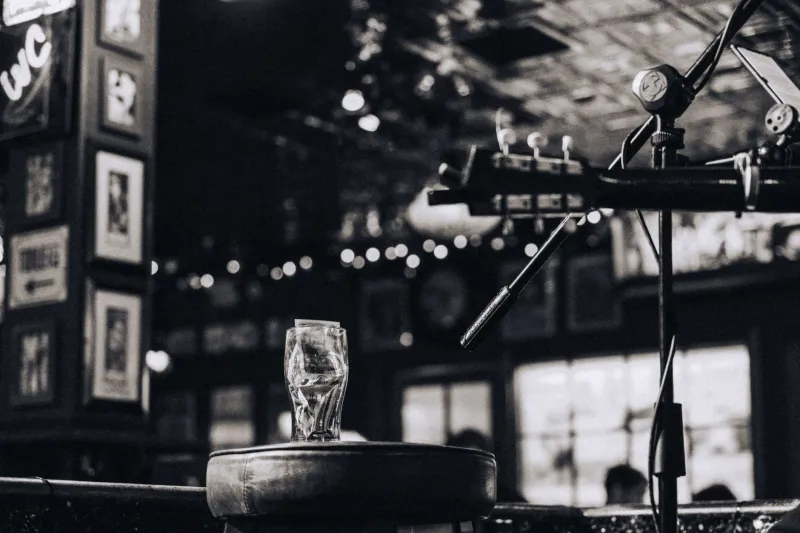
The arch pub has hard floors and a low ceiling. Tables go to the side; the stage is the corner where the fruit machine used to be. The corner pub on the Hove border has carpet and heavy tables. Two staff move each one; it takes longer, but the room feels warmer. The upstairs room above a King's Road bar is the simplest: tables become a merch desk, chairs go along the wall, and the band sets up in front of the window.
In all three, the same thing happens at 9pm: the room changes gear. Diners finish their drinks. Gig-goers arrive. The staff become diplomats.
The 9pm politics
There is always a table that doesn't want to move. It belongs to the people who arrived at seven, ordered the pie, and are now settled. They are not wrong. They are also in the way. The best pub staff don't ask them to move; they ask them to shift. "You can stay," they say, "we'll just put the amp there." The table stays. The amp goes on a chair.
Regulars guard sightlines the way other people guard parking spaces. At the arch pub, a man in a Harrington jacket stands by the pillar until the band starts. He has done this for years. He is not moving. The staff work around him. The band work around him. He becomes part of the stage.
Why borrowed tables make the best stages
A purpose-built venue gives you a black box and a barrier. A pub gives you a table with a pint ring on it and a chair that wobbles. The band are close enough to see the setlist. The audience are close enough to see the setlist too. There is no fourth wall, only a borrowed table and a cable taped to the floor.
That is the point. The room is not pretending to be a venue. It is a dining room that has agreed to become one for two hours. The furniture is the evidence. The table legs know the setlist. The chairs have heard the soundcheck.
After the set
At half eleven, the room goes back. Chairs down, tables back, the rug unrolled. The band load out through the front door. Someone finds a pint glass on a windowsill and puts it behind the bar. The regular in the flat cap finishes his drink. The staff stack the last chair. By midnight, the dining room is a dining room again.
It is not glamorous. It is not meant to be. But it is the reason a gig in Brighton feels like a gig in Brighton: the sea outside, the amps inside, and a borrowed table holding it all up.